An Homage to the Dalston Sainsbury's
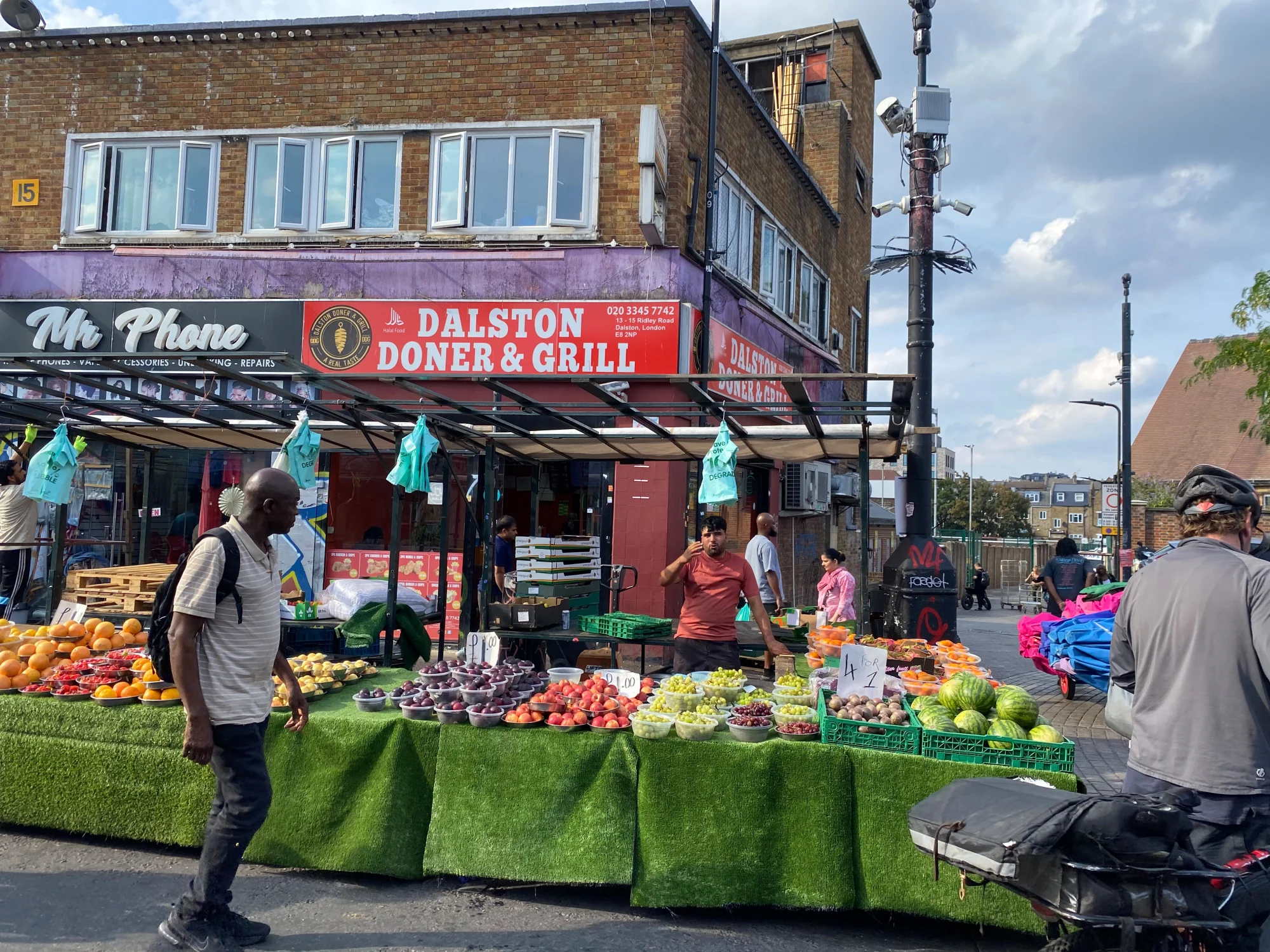
My weekly shop starts with fruit and veg at Ridley Road Market, shoulder to shoulder with fellow patrons under a market stall. It ends with topping up on long life items, under Sainsbury’s fluorescent lights. The 50m walk between the two destinations tells you more about London than either place can alone. In those fifty metres, the smell of fried plantain gives way to bus exhaust, and a preacher’s megaphone competes with market trader’s shouts. Passionate cries to Free Palestine alongside today’s deal on Dominican Mangos. Dalston does not resolve into one story so much as it lets several run at once, and that short walk is where you feel all of them at the same time.
Dalston is home to two urban rail stations in the north east of London, connected by the Mildmay and Windrush Lines, two air-conditioned and spacious suburban services that link this corner of Hackney to the literary associations of Hampstead in one direction, and south, to the ancient churches of West Croydon in the other. You step off a quiet train at Dalston Kingsland station, come down the stairs, and the transition is immediate. There is no gentle approach. Ridley Road runs directly opposite the station entrance. The first thing you meet is not pavement but the market itself, stalls pressed close on both sides of a narrow street. Only after passing through this stretch of noise and colour, past the fruit, fabric and fish, does the street open slightly into the 1980’s Shopping centre, an indoor arcade with a smaller market of its own tucked inside it. Walk through its entrance, past a few more stalls under a lower ceiling, and you arrive, almost without warning, at the sliding doors of a Sainsbury’s supermarket.
I do not treat that stretch of Ridley Road as a corridor to get through on the way to the supermarket. It is where I shop: the prices are extraordinary. A bowl of peppers or a hand of green bananas here costs a fraction of what the same items go for on a shelf a hundred metres away and there is also social interaction which the next bit of my writing will explain. The satisfaction in this has nothing to do with novelty. It is being recognised by a trader from the week before, being handed something ripe because they know you will be back. To walk this stretch properly, rather than simply through it, is to engage with Dalston rather than merely witness it, and it is only once you understand that engagement that the final few steps into the supermarket start to feel strange.
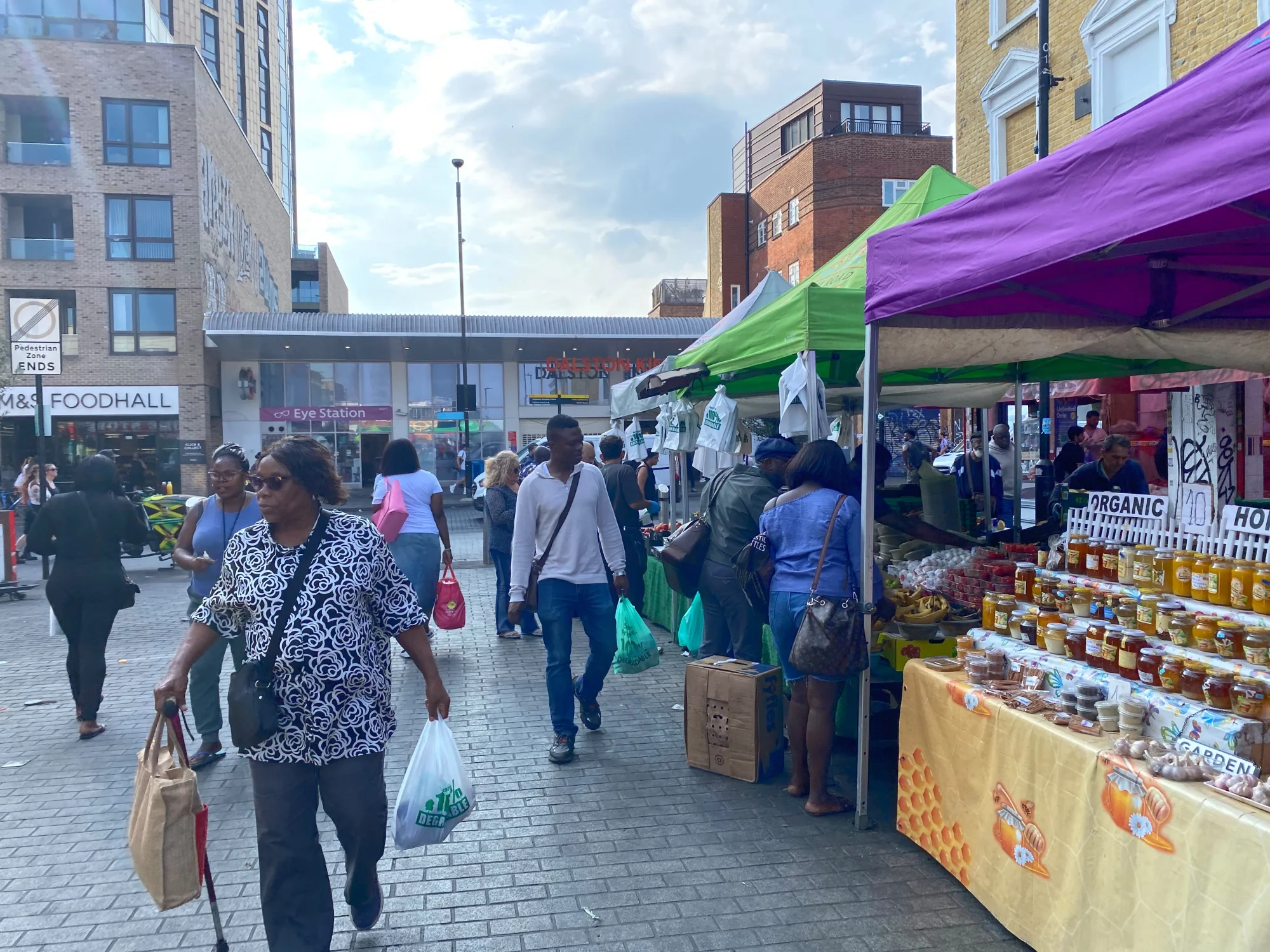
Dalston Kingsland station, with the market beginning directly opposite the entrance.
That last threshold is where the character of the place shifts fastest. One moment you are still inside the market’s noise and clutter, the next you are standing under fluorescent strip lighting with a trolley in your hand, and the change happens in the space of a few steps rather than a few streets. The sound changes register first: the beep of the self-checkout, a trolley wheel catching on lino, reggae bass still faintly audible through the wall from the stalls you just walked past, all overlaid now with the store’s own radio playlist. The visual shift follows just as fast, matte grey shelving and sans-serif price tags after the hand-written cardboard signs and glinting sequins you were standing beside moments earlier. But the mixing that defined the market does not stop at the door, it simply changes register along with the sound. Two aisles in, you will hear at least three languages between customers, and see a checkout queue that could be a cross-section of the whole borough: a Turkish barber still in his apron, someone in yesterday’s glitter buying paracetamol, a Caribbean grandmother inspecting scotch bonnets with forensic suspicion, a tech worker in noise-cancelling headphones who has clearly not looked up in three aisles. This particular branch has, in its own fluorescent way, become as much a melting pot as the market outside it.
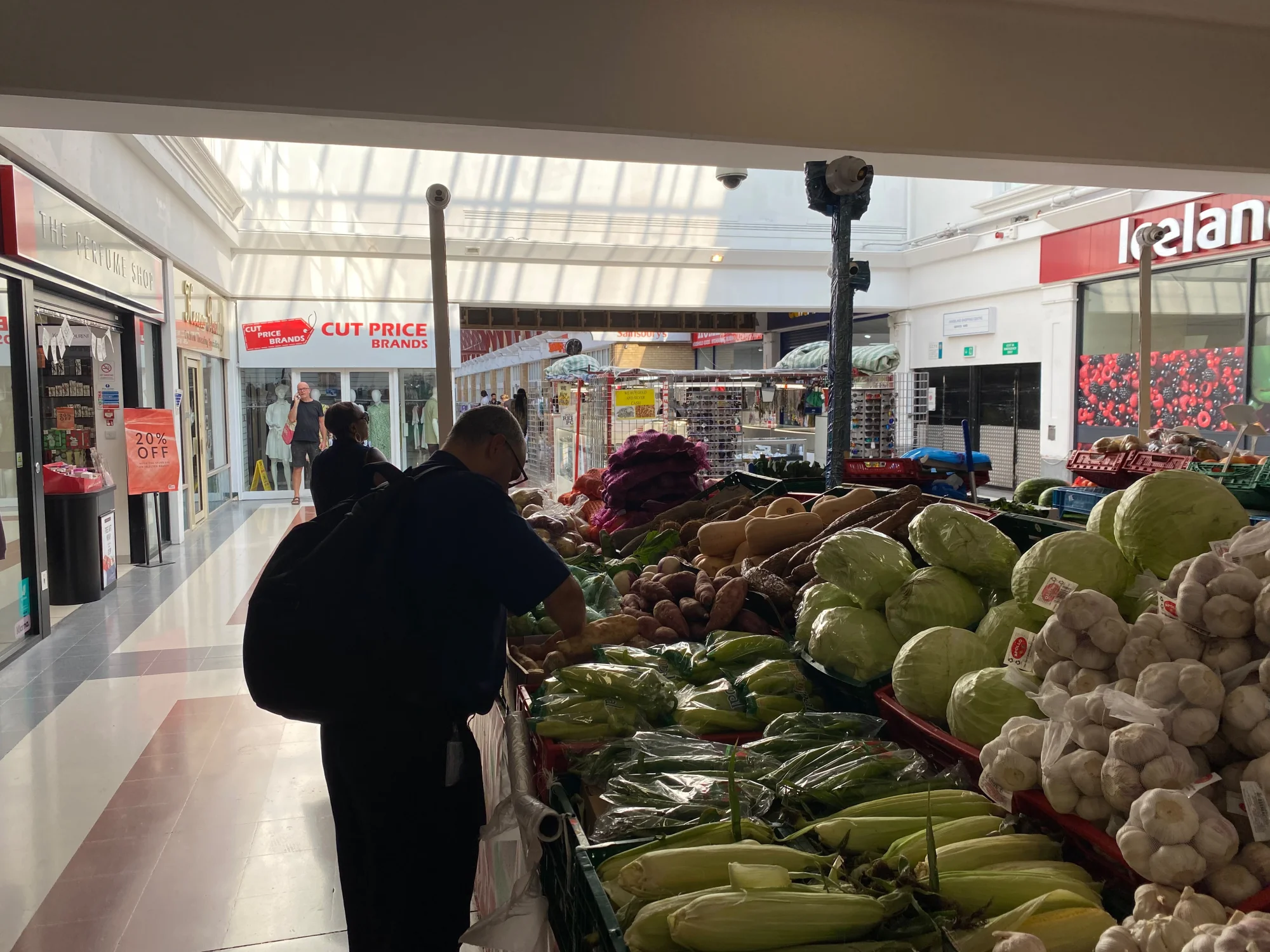
The Ridley Road Shopping Village: a few more stalls under a lower ceiling, then the sliding doors.
None of what you are sensing in that queue is accidental, and it is not only atmosphere, it is measurable. What you are perceiving, without necessarily naming it, is spatial mixing: the co-location of demographically distinct populations within a single, small footprint. Dalston’s census output areas show some of the sharpest socioeconomic gradients in London compressed into a few hundred metres, new-build flats a street away sitting against long-established Windrush-generation housing. A footfall model would show this Sainsbury’s and the market outside it drawing from an almost identical catchment radius, which is exactly why the till queue sounds and looks the way it does. It is a physical sample of a population that, in most of London, would never share a room, let alone a queue.
Zoom out from that till queue and the same logic holds at the scale of the whole junction. Dalston’s chaos is not random, it is the product of geometry and history layered on top of each other: two rail lines converging, a market that predates both of them by decades, and a road network that funnels pedestrians through this one narrow stretch whether they intend to stop or not. This is what the architect and theorist Bill Hillier, founder of Space Syntax, described as the relationship between spatial configuration and movement, the idea that some streets accumulate life not because of what sits on them but because of how they connect to everything around them. Ridley Road is what space syntax would call a highly integrated segment, a street so well connected into the surrounding grid that footfall arrives there almost by default. Dalston Junction, then, is not simply a busy place: it sits near the top of a spatial hierarchy of gathering, a point the city’s own geometry has singled out as somewhere people are drawn to, rather than somewhere they merely pass through.
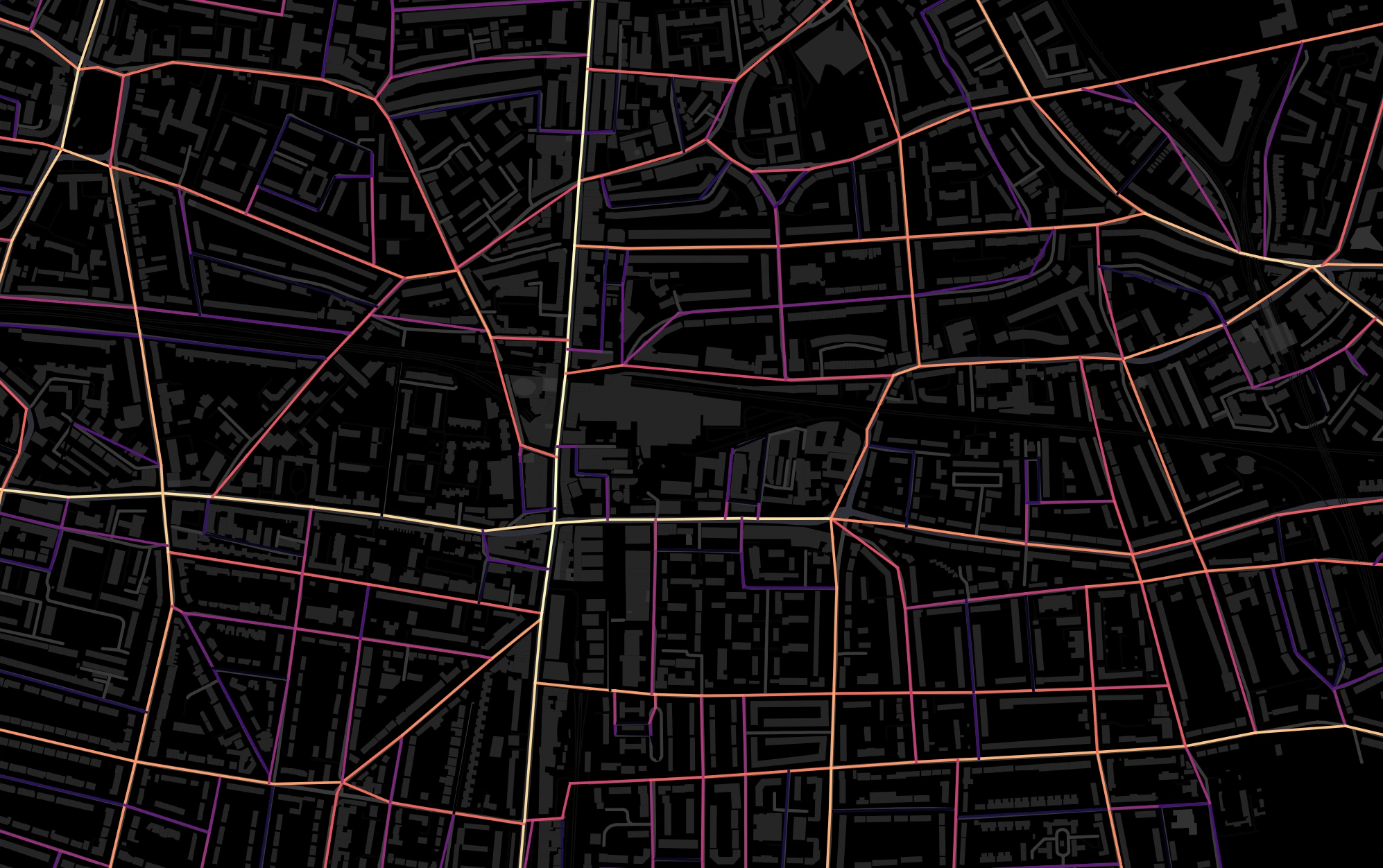
Brighter segments are better connected into the surrounding grid, and so accumulate footfall by default.
Every week, I make that same walk, past the peppers I already know are cheaper than anywhere else, through the noise, into the fluorescent quiet, and without trying, I collect a small dataset just by standing in the queue: accents, languages, baskets, the residue of the market still audible through the wall. The trains outside keep running, spacious and quiet, north to Hampstead, south to Croydon, while underneath them, this one supermarket keeps quietly proving that London’s diversity is not an abstraction, and has not yet been flattened into a single, sellable idea of itself. It is something you can still hear at the checkout.
The fluorescent hum of Big-Grocery takes over. Organic Almond Milk is on sale.